


Make Money: Word Search
4.8414.00 Reviews
App Specs
- Version
- 1.0
- Updated On
- License
- Free
- Downloads
- 100,000+
- Developer
- PAmos
- Categories
- Word
- Platform
- Android
Screenshots

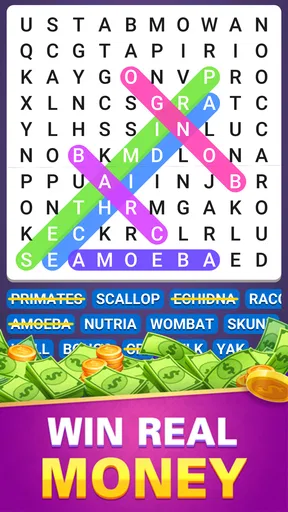

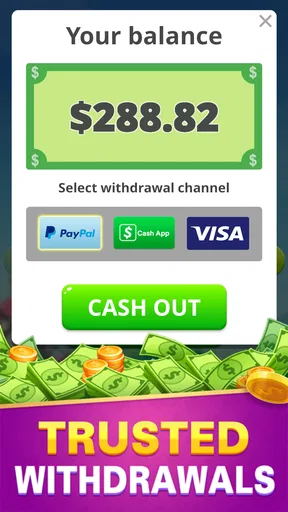

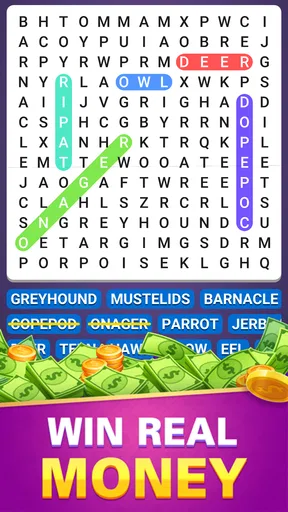
 Analysis by AppCompare
I approached Make Money: Word Search as a small word game first and a rewards app second. That distinction matters. Its central activity is familiar: I scan a letter grid, trace hidden words, and move on to another puzzle. The unusual part is the promise that this simple routine can also lead to real-money rewards. In my experience, that makes the game more interesting to try, but it also means I judge it more carefully than a normal word search.
The game comes from PAmos and sits in the word-game category. It is free to download, which removes the biggest barrier to trying it, while its Mature 17+ rating makes it unsuitable for younger players. The current release is version 1.0, and it runs on devices using Android 5.1 or later. Those details make it accessible to many older phones, although the age rating is something families should take seriously rather than treating this as an automatically child-friendly puzzle.
How the word-search experience feels in everyday use
The basic appeal is easy to understand. Word searches are comfortable games for short sessions because they do not require a complicated tutorial or a large time commitment. I can open the app when I have a few spare minutes, focus on the grid, and stop when my attention is needed elsewhere. That makes it a natural fit for a commute, a waiting room, or a quiet break after work.
What I like most about this format is the gradual change in attention it creates. At the beginning of a puzzle, I look for obvious horizontal and vertical patterns. Once those are gone, I slow down and inspect diagonals, reversed spellings, and clusters of letters that initially look meaningless. The activity is simple, but it rewards patience more than fast reflexes. If you enjoy finding visual patterns, that is a stronger reason to try it than the reward angle alone.
The game also works well for people who want something less demanding than a traditional crossword. A crossword asks me to retrieve clues and spell answers from memory. A word search gives me the word and asks me to locate it, so the mental load is different. I can play it when I am tired without feeling that I have failed an intelligence test. On the other hand, players who want deep vocabulary practice or layered clues may find the format too straightforward.
A realistic use case is a short evening routine. I might play one puzzle while waiting for tea to brew, then put the phone down instead of committing to a long level-based game. The reward promise gives that small session an extra purpose, but I would not make the mistake of treating it as dependable income. The puzzle is the part I can directly enjoy; any financial outcome should be viewed as a possible extra rather than the reason to plan my day around the app.
Where the reward promise changes the decision
The phrase “make money” naturally raises questions that do not arise with an ordinary word search. How much effort is required? What actions lead toward a reward? How long does it take to reach a withdrawal point? I would want to inspect the in-app reward rules carefully before investing serious time. The store summary presents rewards as part of the experience, but a careful user should still read the conditions shown inside the game and avoid assuming that every completed puzzle has the same value.
Worth Reading Before You Choose

EA SPORTS FC Mobile 26 Is a Bigger Football Game, but It Takes Time

Flipboard Shows What News Apps Must Do Beyond the Feed

Switching to Android Auto Means Rethinking Your Driving Routine

Google Calendar Makes a Crowded Week Easier to Manage

Ludo King Makes the Most of the Minutes Between Plans

Baby Panda World Brings Quick Play to Modern Phones, but Its Game Library Feels Busy
My practical advice is to treat the first session as an evaluation period. Play long enough to understand the puzzle rhythm, look at how progress is displayed, and check whether the reward explanation is clear. Do not share more personal information than the app genuinely requires, and do not spend money trying to accelerate progress. Since the game is free, there is no sensible reason to turn a casual test into a financial commitment.
This is also where the Mature 17+ rating becomes important. I would not hand the phone to a child simply because the main activity looks harmless. Reward-based apps can involve decisions and expectations that are better handled by adults. Parents who want a word game for younger players would be better served by a conventional educational or family-focused title with no money-related premise.
Another useful habit is to separate entertainment tracking from reward tracking. I would judge the puzzle itself by whether the grids remain readable, whether finding words feels satisfying, and whether I want to return. I would judge the reward side by clarity and practicality. Keeping those questions separate prevents a disappointing reward experience from making the actual word-search mechanics seem worse than they are, and it prevents a pleasant puzzle from causing me to overlook unclear conditions.
Strengths that stand out during play
The first strength is accessibility. The concept is immediately understandable, and the minimum operating-system requirement of Android 5.1 or later means the game is not limited to only recent devices. That matters for anyone using an older phone as a secondary device or trying to conserve money instead of upgrading hardware just for casual games.
The second strength is the low-pressure nature of searching. There is no need to memorize a large ruleset before beginning. I can settle into a visual scanning rhythm, and that makes the game suitable for brief breaks as well as longer relaxed sessions. It is also a good choice for people who enjoy quiet concentration but do not want the constant alerts and fast decisions common in action games.
The third strength is the combination of a familiar activity with a different motivation. A normal word-search app may provide points, streaks, or completion markers. Here, the possibility of real-money rewards gives the same basic puzzle a practical hook. Even when I remain skeptical about the value of those rewards, I can understand why someone might prefer this over a word search that offers only an in-game score.
The public response suggests that many players find the overall idea appealing. The game has an average rating of 4.8 from around 15 thousand ratings, with more than 400 written reviews and over 100 thousand installs. I do not treat those figures as proof that it will suit everyone, but they do indicate that the concept has attracted a meaningful audience. I would still read recent user comments for clues about the actual reward experience, because a high overall rating cannot answer every practical question.
One non-obvious advantage is that the game can serve as a test of my own patience. If I usually abandon puzzles as soon as the easy words disappear, this format shows whether I enjoy the slower search phase. That is useful before spending time on any reward-focused routine. The real value may be discovering that I like the activity enough to continue even when the incentive is modest.
The limitations I would consider before installing
The largest weakness is built into the premise: rewards can create expectations that a simple puzzle may not satisfy. A player may begin with the idea of earning meaningful money and then feel frustrated if progress is slow or if the conditions are more restrictive than expected. Because the game is free, I would not call that a financial risk in itself, but time is still a resource. Ten minutes repeated many times is not truly free if the experience becomes tedious.
The game may also be a poor match for anyone who dislikes repetitive visual scanning. Word searches offer variation through word placement and themes, but the fundamental action remains the same. If I want evolving strategy, character development, competitive multiplayer, or a clear long-term campaign, I would choose another genre. Even among word games, a crossword, an anagram game, or a spelling challenge may provide more variety.
There is a second trade-off between convenience and scrutiny. The easy-to-understand puzzle can make the app feel uncomplicated, while the money-related side encourages me to pay closer attention to instructions. I would not rush through notices or assume that a reward is immediate. Before committing to regular play, I would verify what counts as progress, whether there are thresholds, and what steps the app presents for receiving rewards. That is not cynicism; it is sensible reading whenever an app connects play with money.
Version 1.0 is another reason I would keep expectations measured. A first release can be perfectly usable, but it may also feel less mature than a long-established word-game alternative. I would pay attention to how smoothly it behaves on my particular phone and whether the interface remains comfortable during extended searching. Older hardware may meet the operating-system requirement yet still deliver a less pleasant experience if the device is slow or the screen is small.
The rating also narrows the audience. Adults looking for a casual puzzle can make their own judgement, but families searching for a safe shared word game should look elsewhere. The Mature 17+ label is not a minor footnote in this case because it sits alongside the reward promise. I would recommend checking the app’s suitability for the intended player before installation, especially on a shared device.
How it compares with ordinary word games
Compared with a standard word-search app, this game has a clearer practical hook. A conventional alternative may be better if I simply want a clean, distraction-free puzzle with no expectation beyond entertainment. Such an app can be easier to recommend to children, and it may feel more transparent because the purpose is only to solve grids. Make Money: Word Search is more appealing when the possibility of a reward is part of the motivation.
Compared with crossword games, it is easier to enter but less demanding in language recall. I do not need to solve clues or construct answers from definitions. That makes it friendlier for casual players and for moments when concentration is limited. Crossword fans who want richer vocabulary work may find the experience shallow, while people who prefer visual recognition may enjoy it more.
Compared with anagram games, the pace is calmer. Anagrams often reward quick rearrangement and a broad vocabulary, whereas a word search lets me use systematic scanning. I can improve by changing my search method: checking unusual starting letters, following likely word directions, and returning to dense sections after clearing the obvious finds. That methodical quality is one of the game’s best reasons to exist, even without the financial angle.
The trade-off is that the reward premise can make comparison less direct. A normal game is judged almost entirely by design and enjoyment. Here, I also have to judge whether the incentive feels worth the attention it demands. If the puzzle is enjoyable but the reward process feels confusing, I would keep playing only as a casual word game. If I want predictable entertainment, a non-reward alternative may be the better choice from the start.
Who will get the most from it
I think this game is best for adults who already enjoy word searches and like the idea of adding a possible reward to a familiar pastime. It suits people who want short, low-pressure sessions rather than a demanding competitive experience. It may also appeal to someone who is curious about reward-based games but wants to begin with a simple activity instead of a complicated strategy title.
I would recommend starting with a modest routine: try a few sessions, learn the puzzle flow, and decide whether the searching remains enjoyable without counting every minute. This approach protects the main benefit of the game, which is easy casual play, while reducing the risk of chasing an uncertain outcome. If the reward system turns out to be clear and worthwhile for you, it can become an added reason to return. If not, you will know quickly whether the word-search portion stands on its own.
I would skip it if I am looking for guaranteed earnings, a serious income source, or a game with substantial progression. I would also skip it for children because of the age rating, and I would choose a different word game if I want clues, competitive leaderboards, or advanced vocabulary challenges. People who dislike ads, reward conditions, or repeated scanning should be especially cautious about whether the central loop fits their habits.
My final verdict
Make Money: Word Search is most convincing when I see it as a casual word-search game with a reward-oriented twist, not as a replacement for work or a reliable way to earn. The accessible format, free entry, and relaxed puzzle rhythm make it easy to try. Its strong public rating and growing install base show that the idea connects with many players, although those signals should complement rather than replace my own check of the in-app experience.
My recommendation is therefore specific: adults who genuinely like finding hidden words should give it a careful trial, read the reward details, and keep their expectations realistic. Players who want a pure family puzzle, deeper wordplay, or dependable financial returns should choose another option. The smartest way to use it is to value the puzzle first and treat any reward as a bonus, never as a promise that justifies unlimited time.
Pros
- Simple gameplay that is easy to learn for players of all ages.
- Word lists help improve spelling and vocabulary while playing.
- Short puzzles fit well into quick breaks or commutes.
- Cash-themed rewards add extra motivation to complete puzzles.
- Works well for relaxing
- low-pressure casual gaming sessions.
Cons
- Reward progress may feel slow without completing many puzzles.
- Frequent ads can interrupt gameplay between word-search rounds.
- Some rewards or features may require watching promotional videos.
- Puzzle difficulty may become repetitive for experienced players.
- Earning money is unlikely to replace a regular source of income.
FAQs for Make Money: Word Search
What is Make Money: Word Search?
Make Money: Word Search is a casual word puzzle game that combines traditional word-search gameplay with a rewards-based system. You find hidden words in letter grids, complete levels, and may receive in-game points or rewards for your progress. It is designed for short play sessions and is generally easy to understand, although the actual earning experience can depend on available offers, eligibility, and the app’s current reward policies.
How does the gameplay work?
The main objective is to locate the words listed on the screen within a grid of letters. Words can usually appear horizontally, vertically, diagonally, or in reverse, so carefully scanning the board is important. As you complete puzzles, the difficulty may increase through larger grids, longer word lists, or limited assistance. The game is straightforward for beginners, but later stages can require patience and concentration.
Can you really make money with Make Money: Word Search?
The app presents itself as a way to earn rewards while playing word-search puzzles, but users should maintain realistic expectations. Reward systems commonly depend on points, milestones, advertisements, surveys, or other promotional activities, and reaching a withdrawal threshold may take considerable time. Before investing too much effort, review the current terms, minimum payout requirements, supported payment methods, and user feedback because rewards and availability may change.
Is Make Money: Word Search free to download and use?
The application may be available to download without an upfront purchase, allowing users to begin playing at no initial cost. However, free apps often include advertising, optional purchases, or reward-related conditions. You should check the store listing for details about in-app purchases, subscriptions, data collection, and any restrictions. An internet connection may also be required for advertisements, account features, reward tracking, or withdrawals.
Is Make Money: Word Search safe for children and personal data?
Parents should review the app’s age rating, privacy policy, permissions, and advertising practices before allowing children to use it. Reward-focused applications can include third-party advertisements, external links, or requests for account and payment information when users attempt to redeem rewards. Avoid sharing unnecessary personal details, never provide sensitive financial credentials outside trusted payment channels, and download the app only from an official Android or iOS store.


